Strategy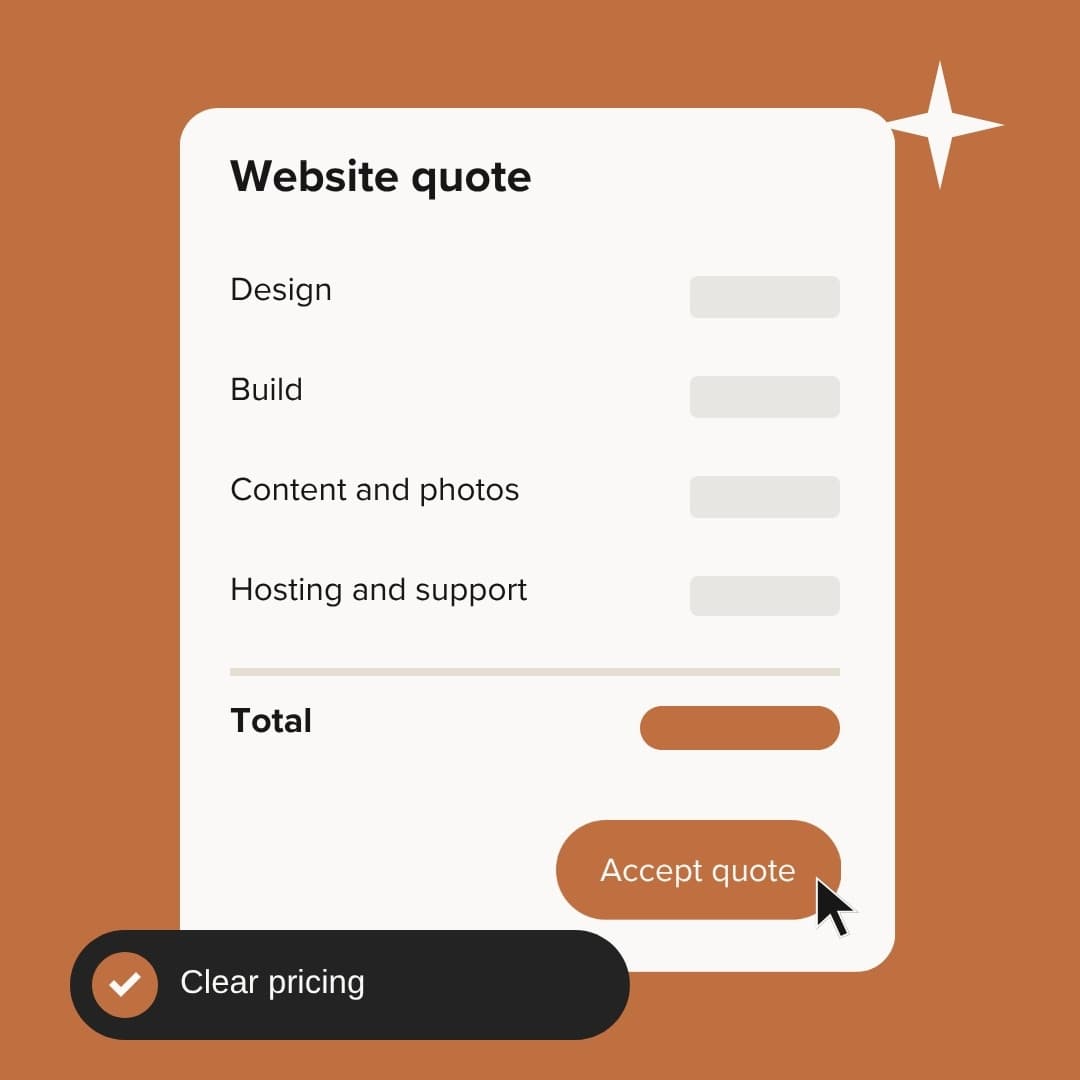
What goes into the price of a website
2 min read
Ask three web designers for a quote and you might get three very different numbers. That doesn’t always mean one of them is overcharging. Usually they’re pricing different things, and the quotes only make sense once you know what each one includes.
The number of page layouts
A site with 20 service pages that share one layout can cost less than a site with eight pages that all look different. Each new layout has to be designed and built, while adding a page to an existing layout takes far less time. Ask how many layouts the quote covers.
Who writes the words and takes the photos
Content is often the part left out of cheaper quotes. Someone has to write clear copy for every page and supply good photos of your work. If that’s you, set aside the time. If it’s the designer, it should be in the quote as its own line.
What the site needs to do
A site that explains your services and takes enquiries is the simplest kind. Online booking, payments, a product catalogue, a quote calculator or a link to the software you already use all add work, because each one has to be built, tested and kept working.
Built for you, or adapted from a template
A template is quicker to set up, and for some businesses it’s enough. A site designed and built for you costs more at the start, but it fits your business instead of the other way round, and it can be faster and simpler to look after. Check which one you’re being quoted for.
What it costs to run
A website has running costs: the domain name, hosting, email, and someone to make changes and keep it secure. Some quotes include a year of these and others leave them out, so ask what the site will cost to run each year as well as to build.
Comparing quotes
Ask every designer for an itemised quote, so you can compare like with like and see what’s missing. It’s why we don’t publish a price list: we’d rather talk through what your business needs and price exactly that than quote a figure that turns out to be wrong.
Related service
Brochure websites
A website that explains what you do and makes it easy to ask for a quote.
Thinking about a new website?
It starts with a free, no-obligation chat. You get an itemised quote before any work starts.
Get in touch